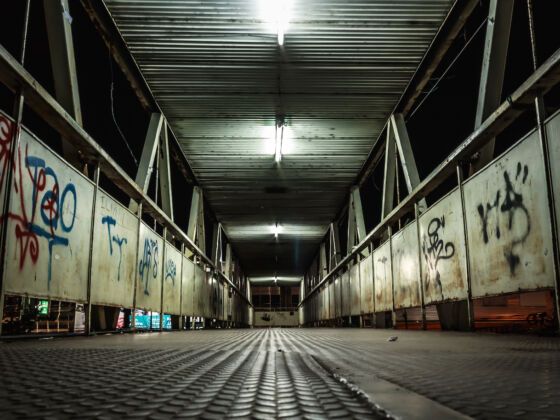
Photo: colin.brown
A few weeks ago, Matador Trips editor Carlo Alcos posted a healthy reminder for us to keep our common sense about us when on the road.
It’s an important message aimed at travelers worldwide. But Americans might require an additional precaution — for times when they’re not on the road.
Common knowledge has it that many American urban areas are dangerous places, virtual no-gos to anyone who doesn’t have the misfortune of living there. And most frequently when talking about urban crime, we toss around city names: New Orleans, Detroit, St. Louis, Oakland.
But cities are big places. They have their stereotypical dicey areas of pawnshops and abandoned warehouses, but also their Whole Foods yuppie zones, with maybe even a country club thrown in somewhere.
Which is why a list posted on www.walletpop.com is so interesting. It ranks individual neighborhoods by “predicted rates of violent crime.” Here are the top 10:
1. Central Pky./Liberty St., Cincinnati, OH (45210, 45214)
2. State St./Garfield Blvd., Chicago, IL (60609)
3. 7th Ave./North River Dr., Miami, FL (33128, 33130, 33136)
4. Beaver St./Broad St., Jacksonville, FL (32202)
5. North Ave./Belair Rd., Baltimore, MD (21213)
6. Bales Ave./30th St., Kansas City, MO (64127)
7. Warford St./Mount Olive Rd., Memphis, TN (38108)
8. Forest Ave./41st St., Kansas City, MO (64110)
9. Route 352/Scyene Rd., Dallas, TX (75210)
10. Church Hill, Richmond, VA (23223)
You can read about the methodology used in the ranking process here.
Photo: max_trudolubov
Comparing the results to a 2008 list of America’s most dangerous cities brings up a lot of questions.
It seems the country’s most violent neighborhood is located in Cincinnati (in an area known as the “Brewery District”). But Cincinnati doesn’t even show up in the top 20 city rankings.
At the same time, New Orleans, 2008’s most dangerous city, is nowhere to be found on the neighborhood list. And the first mention of Detroit — that favorite whipping child — comes at 23rd.
Which do you think is a more accurate method for measuring location-based danger? And beyond that, do you think lists like this are helpful and informative or nonconstructive and fear mongering? Share your opinion in the comments.
Community Connection
Interested in taking this research one step further? Connect with Matador community members from different parts of the U.S. and see what they’re saying about their home neighborhoods.You can browse a list of locations here.
About the Author
Related Posts
13 Comments... join the discussion!
-
-
Hal-
Great idea for an article.
I’m not surprised Detroit’s so low on the list–it’s an all but abandoned city, from what I’ve seen and read about it.Wonder where Washington, D.C. falls.
I don’t think these kinds of lists are necessarily useful. How are they going to change the phenomena related to crime? They won’t. They’ll only scare people away from visiting, which will be likely to further undermine the local economy and stimulate crime.
↵ -
I agree with Julie’s points above…I also think it’s important to utilize common sense and take safety precautions no matter where you are, while still keeping an open mind and realizing that the majority of people you encounter, including in the poorest neighborhoods, aren’t violent criminals.
↵ -
I agree with Julie- there are so many ways of ranking the heatlh/happiness of a city that unless it’s a positive list, I don’t understand the point. In particular, making lists that are going to portray cities as undesirable when they’re already suffering in this economy just seems like kicking them when they’re down.
↵ -
Lists like this are iffy at best. I mean what’s the likelihood of winding up in one of these specific neighbourhoods at random? Any traveler worth his salt would get the low down on city areas before exploring them…city residents know the hotspots and flashpoints better than any remote list makers…
↵ -
I don’t necessarily think a list like this is totally unproductive. I would say narrowing it down to specific parts of cities is definitely more accurate than labeling an entire city dangerous. This gives a better picture, and if it’s based on police statistics, well, that’s pretty hard to argue. Police stats are always lower than reality too, considering the amount of crime that goes unreported.
I don’t think the list would keep tourists away. I think the tourists would stay away anyway, because as Paul says, they will find out one way or another. If anything, maybe a list like this will prompt officials to take action in cleaning the crime up. Or, maybe I’m just being naive.
↵ -
I cannot see how they left “Camden” New Jersey out of this research list! Camden,directly across the Delaware River from Philadelphia Pa. is so horrible CBS’s 60 Minutes a couple of years ago did a story on it and the journalist (Mike Wallace I think) stated even the toughest Philly gangs stay away from Camden because it is so violent and brutal! The US has a public urinal and it is called “Camden” New Jersey!!!
↵ -
Julie, Detroit is far from abandoned. We’ve just been struggling with one of the most corrupt city governments in decades and we’re coming back in a big way. Detroit is a city that’s been badly mistreated but is now (in my opnion) resting in good hands.
↵ -
And besides that, you always have the Red Wings! Well, except for last year…
↵ -
Although this article is written about the US, it hits home with me and how Mexico has been suffering from media portraying it as a dangerous country as a whole. Generalizations are never good and in our case, have been highly detrimental to the Mexican tourism industry.
I do have to wonder how effective these lists can be though—even over here. Would travelers really differentiate or still see a name and assume that everything linked to it is dangerous? Perhaps, as Carlo says, it might prompt officials to clean up but that’s really the only benefit I can see from here.
↵ -
this is quite obsurd to me. i grew up in the calliope projects where there were killings after killings day by day. kids i knew had guns before they turned ten and we all got tats as soon as we could to represent our area. there was nothing positive that came from here and all my friends were either killed or in pison before the age 25. they torn down the cp3 along with many other projects such as the magnolia after i was locked up and if it wasnt for me getting locked up i probrably wouldnt of been here today. its nothing pure out there but the intent to kill for your brothers and hustle for your bread. my mother only paid about 30 dollars a month to live there and there wasnt one night that you wouldnt hear gun blasts. i last went there in 2006 and it seemed just like it had always was if not worse. whenever i go to see my fam it reminds me and shows me that there is nothing to live for here, its like africa but i would say more violent if you knew what we saw. ill say it till the day i die, i live in atlanta now and ive never seen anything like home and i dont believe anywhere in america would ever compare to the struggles of the 3rd ward new orleans, it will always be the murder capital till its all gone something i believe no matter how bad will be sad for all us 3rd ward creoles to say goodbye too.
↵


