Backpacker’s Secret Guide: Champasak, Lao PDR

04/23/08  Print This Post Print This Post    14 Comments   Popular   Written by Hal Amen
  • Stumble It

Photo by Hal Amen

Bouncing around Southeast Asia? Stop and relax for a few days among the ancient temples of southern Laos.

Zipping down from Luang Prabang?

Cruising up from Phnom Penh? Shooting over from BKK? Make sure to cool your jets for a few days in the southern Lao town of Champasak.


Orientation

Champasak lies 25 miles downstream from the southern hub of Pakse. It’s on the shore opposite the highway, accessible by boat from the Ban Muang docks.

Nearly the entire town is laid out along a single road that parallels the Mekong River. In the center, a traffic circle (with no traffic to speak of) rings a decaying stone fountain that hints of this town’s distinctive past.


Faded Grandeur

photo by Hal Amen

In Champasak you’ll find the same “go with the river’s flow” mentality celebrated by backpackers further north at Muang Ngoi Neua and further south on the Four Thousand Islands. But there’s more to Champasak than banana milkshakes and hammock naps.

Before the French consolidated the region and added that pesky “s” to the name, there were three separate Lao kingdoms. One of them just so happened to be the Kingdom of Champasak, seated in the town that still bears its name.

It may be hard to believe this lazy village once hosted royalty. But while it lacks anything approximating Pakse’s Champasak Palace Hotel, there are faded reminders of greatness to explore.

Some of Champasak’s grandeur remains in the colonial buildings, stained by the weight of time and humidity, that line the main road. Enjoy the atmosphere conjured by these shadows from the past as you relish a slow meal of laap, sticky rice, and Beer Lao at one of the many delightfully mellow riverside restaurants.


The Main Attraction

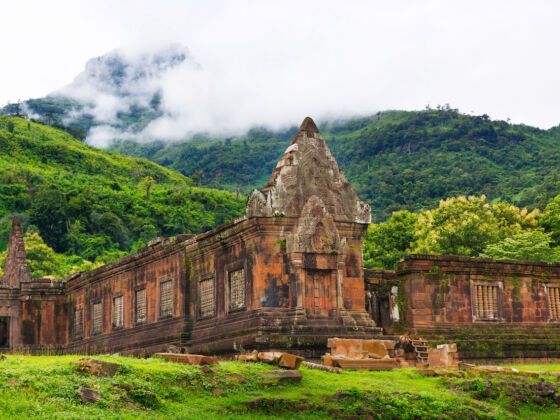
Champasak boasts something else unique in southern Laos: a UNESCO World Heritage Site.

Champasak boasts something else unique in southern Laos: a UNESCO World Heritage Site. The ruins of Wat Phu Champasak straddle the mountains and the Mekong plain 7 miles south and west of town on the main road.

If you’re planning a visit to Angkor Wat later in your trip, Wat Phu is the perfect prelude for what you’ll see there. Travelers who have already been to Angkor will appreciate the elevated location of these ruins. Wat Phu affords impressive views, something you don’t often find at Angkor.

This temple complex served as the spiritual nexus of an ancient culture as early as 2,000 years ago.

Centuries later, Champasak became part of the vast Khmer empire, and you’re sure to note the similarities between the sculptures and carvings here and those at Cambodia’s world-renowned site. If you look closely, you can see remnants of the pilgrimage route that once connected the two.

Today, Wat Phu invites you to relive the experience of a devotee as you ascend the stone staircases scented with sweet frangipani blossoms that connect the site’s multiple levels.

Along the way, you’ll pass statues decorated in saffron robes and fresh flowers, perhaps with a group of monks in attendance.

From the top level, it’s possible to look back over the entire complex, further out across the colorful plain, and eventually to the Mekong shimmering in the distance.

Each year, the ruins are overrun with local revelers during the Bun Wat Phu Champasak. Sporting events, Buddhist ceremonies, and live music abound at this popular festival.

If your visit happens to coincide (festival dates are determined by the lunar calendar and usually fall in February), book your Champasak accommodation well in advance. At other times of the year you’re likely to have the place to yourself.


Other Sights and Activities

photo by Hal Amen

While it’s a safe bet any visitors to Champasak have come for Wat Phu, other nearby sights reward travelers who choose to linger. For an active temple, check out Wat Nyutthitham one block west of the main drag.

There’s another wat north of the circle where the ferry docks, and yet another can be found about 5 miles to the south, past where the road curves toward Wat Phu.

More Khmer ruins are on display at Um Muang, downstream a piece on the opposite bank. To get there, hire a boat from Champasak for around $10 round-trip. Floating lazily along the Mekong is half the fun.

The flat dirt roads around Champasak are great to explore on your own. Most guesthouses rent out bicycles, and some have motorbikes.

Follow any path and you’re sure to come upon conical-hatted farmers at work in green fields, laughing Lao children, and maybe a water buffalo cooling off in a mud puddle.


Arriving and Departing

Champasak, located just off well-traveled Highway 13, is a breeze to reach. Buses from points north and south travel this road and will probably drop you at Ban Lak 30, a couple miles east of the Ban Muang docks. You shouldn’t have any trouble arranging local transport to cover this distance.

Unless you specify otherwise, your boatman will ferry you a mile or so north of Champasak’s traffic circle. The standard crossing runs less than 10,000 kip ($1).

Alas, the heyday of boat travel in southern Laos is over, and the slow boat connecting Pakse to the Si Phan Don island of Don Khong seems to have been discontinued. Private boats can still be chartered (expensively) in Pakse for the journey to Champasak if you so desire.

Circle of Asia’s “Vat Phou Cruise” package is a roundtrip between Pakse and the Cambodian border, with onboard accommodation.

From Thailand, use the border crossing east of Ubon Ratchathani. Despite its continuing obscurity, there’s also a crossing with Cambodia at Voen Kham. Embassy employees, guidebooks, and tour operators alike may tell you it’s not possible to purchase a visa upon exit/entry, but this author had no trouble doing so.

Your best bet is to arrange transport through a guesthouse on your way down, or in Stung Treng, Cambodia, if coming the other way. As always, check with passing travelers for the latest updates.

Guesthouses and Restaurants

photo by Hal Amen

Champasak guesthouses offer a variety of accommodations, from the standard $3 fan bungalow to larger, indoor rooms with A/C, private bath, and hot water for up to $15. Try to find one with a nice seating area facing the river, where you can string a hammock and contemplate the Mekong’s swift current.

In addition, most of the guesthouses have attached restaurants. The one associated with A Nou Xa Guesthouse, north of the fountain circle, serves carefully prepared and deliciously authentic Lao cuisine, with an atmosphere that can’t be beat.


Cash and the Net

There are no banks between Pakse and Stung Treng, so remember to conduct any necessary financial business before striking out. U.S. dollars are sometimes accepted, Thai baht less so—it pays to stock up on kip.

A couple houses (one just south of the circle) advertise Internet connections, but this is nothing more than a local’s personal computer. Rates are twice what they are in Pakse.

Fewer services means more time for relaxation. Enjoy it while you can!

Community Connection!

Many Matador members have a soft spot for Laos. Check out Matador contributor Justin Landrum’s guide to Muang Ngoi Neua, maybe the chillest backpacker hideout in all of SE Asia.

TravelFish, an online resource dedicated to SE Asia travel, has an excellent Champasak travel guide.

Nomadic Matt recommends Southern Laos in his excellent list of 8 ways to get off the SE Asian tourist trail. Your faithful editor Tim Patterson fell in love with Lusty Luang Prabang. Although his profile is a little sparse, Robb Cadwell knows more about Laos than just about any Westerner.

Matador is blossoming. Click here to join today.


  • Stumble It

About the Author

Matador ID: halamen

Freelance writer and Trips co-editor Hal Amen is currently in the midst of a volunteer year in South America. Find tales of this and other adventures on his personal travel blog, WayWorded.

14 Comments... join the discussion!

  • aya replied on April 23, 2008

    great information about a somewhat hidden wonder. wat phou is indeed a remarkable site, one i'm glad i didn't miss.

    (Report comment)

    ↵ Reply
  • aya replied on April 23, 2008

    great information about a somewhat hidden wonder. wat phou is indeed a remarkable site, one i’m glad i didn’t miss.

    (Report comment)

    ↵ Reply
  • Bill replied on April 24, 2008

    FYI, the "s" was added by the Portuguese long before the French ever came.

    (Report comment)

    ↵ Reply
  • Hal replied on April 24, 2008

    Thanks, Bill, I hadn't heard that. Wikipedia and Lonely Planet both finger the French, but then I guess they're not the most reliable sources.

    In looking into this, I discovered a site that addresses a slightly different facet of the issue: is it "Laos" or "Lao"? Pretty interesting, check it out:
    http://lao-ocean.com/2004/11/05/whats-in-a-name-l...

    (Report comment)

    ↵ Reply
  • Bill replied on April 24, 2008

    FYI, the “s” was added by the Portuguese long before the French ever came.

    (Report comment)

    ↵ Reply
  • Hal replied on April 24, 2008

    Thanks, Bill, I hadn’t heard that. Wikipedia and Lonely Planet both finger the French, but then I guess they’re not the most reliable sources.

    In looking into this, I discovered a site that addresses a slightly different facet of the issue: is it “Laos” or “Lao”? Pretty interesting, check it out:
    http://lao-ocean.com/2004/11/05/whats-in-a-name-lao-or-laos/

    (Report comment)

    ↵ Reply
  • Bill replied on April 24, 2008

    Hal,
    I do not know where I read the reference. But the first instance of the word Laos appears in a 16th century Portuguese document. The adding of the "s" was explained as a linguistic attempt to make the name conform to Portuguese usage. Something like Italians always adding an "a" onto English words.

    On the other issue as to whether it is Laos or Lao. Well, you can ask the same question of other English place names. Is it Holland or the Netherlands, Germany or Deutschland, Ireland or Eire, China or Zhoungo, Japan or Nippon?

    (Report comment)

    ↵ Reply
  • Bill replied on April 24, 2008

    You can find a reference to the Portuguese culpability of adding the "s" here:
    http://www.statoids.com/ula.html

    (Report comment)

    ↵ Reply
  • Bill replied on April 24, 2008

    Hal,
    I do not know where I read the reference. But the first instance of the word Laos appears in a 16th century Portuguese document. The adding of the “s” was explained as a linguistic attempt to make the name conform to Portuguese usage. Something like Italians always adding an “a” onto English words.

    On the other issue as to whether it is Laos or Lao. Well, you can ask the same question of other English place names. Is it Holland or the Netherlands, Germany or Deutschland, Ireland or Eire, China or Zhoungo, Japan or Nippon?

    (Report comment)

    ↵ Reply
  • Bill replied on April 24, 2008

    You can find a reference to the Portuguese culpability of adding the “s” here:
    http://www.statoids.com/ula.html

    (Report comment)

    ↵ Reply
  • Andris replied on April 27, 2008

    Hi Hal,

    Great article! I unfortunately passed right by Champasak on my way from the Cambodian border at Stung Treng to Pakse. Once I was surrounded by comatose Friends-rerun watching backpackers in Vang Vieng I found myself wishing I had spent more time in the much quieter south of Laos.

    Andris

    (Report comment)

    ↵ Reply
  • Andris replied on April 27, 2008

    Hi Hal,

    Great article! I unfortunately passed right by Champasak on my way from the Cambodian border at Stung Treng to Pakse. Once I was surrounded by comatose Friends-rerun watching backpackers in Vang Vieng I found myself wishing I had spent more time in the much quieter south of Laos.

    Andris

    (Report comment)

    ↵ Reply
  • Hal replied on April 28, 2008

    Thanks for the feedback, Andris. If you have more time in the region and want to escape the hordes, check the article "How to Get Off the Tourist Trail in SE Asia" on this site.

    By the way, the photos on your site are amazing! I really enjoyed browsing through them.

    (Report comment)

    ↵ Reply
  • Hal replied on April 28, 2008

    Thanks for the feedback, Andris. If you have more time in the region and want to escape the hordes, check the article “How to Get Off the Tourist Trail in SE Asia” on this site.

    By the way, the photos on your site are amazing! I really enjoyed browsing through them.

    (Report comment)

    ↵ Reply

Leave a Comment

Jump To Category:


Explore the Community


Latest Community Blogs


Popular Stories on Matador

12 Personal Travel Websites That Will Make You Quit Your Day Job

... 

10 Traveler's Tips For Rocking A Nudist Beach

Travelers tend to enjoy ultimate freedom on the road, t... 

10 Volunteer Opportunities For Free Travel

From assisting with disaster relief to helping on the A... 

The 50 Greatest Campfire Songs Of All Time

... 

The A-B-C-D-E of Travel Photography

Action, Balance, Composition, Depth of Field, Evocation... 

10 Things to do in Amsterdam BESIDES Smoking Pot

There's more to Amsterdam than legal bud.... 


Focus


Editor Blogs