Castles, Wine, and History on The Cathar Trail

11/26/08  Print This Post Print This Post    4 Comments   Popular   Written by Beebe Bahrami
  • Stumble It

Photo by Wy@rt

This summer at Montpellier’s food and wine festival, Le Festin de Rabelais, I fell in love with the A.O.C. Corbieres reds.

These earthy wines, whose color is reminiscent of the orange-red soil of the region, inspired me to visit the wilds of the Corbieres. There I found more great wine, good food, incredible places for walks and hikes, and a stunning history, that of the Cathars.

In the middle ages, particularly the 12th and 13th centuries, the Cathars were a spiritual-religious group of people all across France who interpreted Christianity differently from the surrounding Catholic orthodoxy. They were especially concentrated and well-received in the south, in and around the Languedoc-Roussillon region.

They followed what they saw as a more authentic spiritual path, one that held the sensory and material world as the deception of a false god, not a divine creation. The path out of this deception was to deny the material world its power, to live a simple life, and to focus on one’s spiritual origins.

Woven into these fundamentals were the practice of vegetarianism, equality of the sexes, belief in reincarnation, and forsaking material consumption for power and display.

Photo by Beebe Bahrami

In Languedoc, the Cathars were protected by the count of Toulouse and permitted to carry on their ways, unlike in other parts of France where Catharism was treated as heretical. This held until the early 13th century when the Cathars were deemed too successful and independent.

Both the king of France and Pope Innocent III wanted dominion over them: what they really wanted was possession of the south. Together, king and pope came down on the Cathars in a crusade, Christian against Christian, massacring anyone in their path.

Called the Cathar Crusade or the Albigensian Crusade, after the southern city of Albi, this is one of the darkest marks in the history of France and of Christianity.

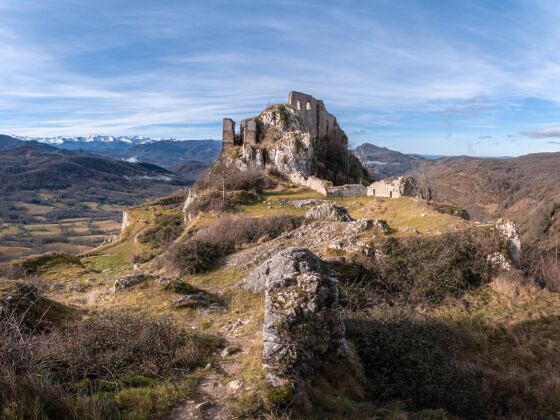
Today, there is still a somber and mournful feel to the sites. As you travel through a vast sea of vineyards and rolling hills, you encounter countless crumbling castle-fortresses on hilltops, reminders of a dangerous past.

There is also a surviving spirit, whispering that the Cathars survived in their own way, and that tolerance is far more valuable than what’s gained through greed and corruption. The Cathars today are something of a romantic group in the country’s imagination. Some people even say there are living Cathars in these remote hills.

Photo by Beebe Bahrami

Here are my recommendations on how to enjoy this region in a low-key and affordable way:

1. You really can’t go wrong on any road you take.

This is especially true if you head from the north around Béziers, Narbonne to Carcassonne, then south to Foix, Limoux, Quillan, Lagrasse, and Durban.

All along the way, vineyards welcome unscheduled drop-in visits and tastings with colorful and often creative roadside signs. You’ll find a warm and welcoming people, so don’t be shy to give it a go and don’t worry if your French consists of the rudiments of the last pages of your travel guidebook. Wine is a universal language and easily understood.


2. Whether you opt to walk, cycle, or drive, follow the Cathar Trail.

The Cathar Trail, or Le Sentier Cathar, gives one of the best cross sections of the Corbieres, not to mentioncovering the major Cathar sites of the wider region. The trail is around 250 kilometers and starts in Narbonne.

It continues to Port-la-Nouvelle, Durban, Padem, Duilhac, Galamus, Bugerach, Quillan, Puivert, Espezel, Comus, Montségur, Roquefixade, and on to end in Foix.

Photo by Beebe Bahrami

    3. Take a few detours:

  • Renne-le-Chateau, near Couiza, for a seriously New Agey place dedicated to both Mary Magdalene and Cathar history
  • Limoux for the warm cheer of the town. Take a picnic lunch along their river, and and try the Blanquette de Limoux, a solid sparkling wine that has absorbed the red mineral of the soil.
  • The castle at Arques, offering a lovely drive through low green hills, along valley streams, and deep into that red earth.

4. The entire Aude, of which Corbieres is a part, is dotted with vineyards and little restaurants and cafes advertising the local vintages and fare. Corbieres has a huge variety of terroirs, a fact you’ll easily understand as you wind around its hills, forests, and streams that result in several different growing zones.

Keep your eye open for restaurants and cafes where the locals are gathering; these are a sure sign of a good place.

Some Resources:

The Cathar Way – A Walker’s Guidebook by Alan Mattingly (ISBN: 9781852844868), published by Cicerone Guides.

The Sentier Cathar – In the Footsteps of the Cathars

The Cathars of Languedoc

Community Connection

Matador member toby has blogged about another French wine warren, the Rhone Valley. And Matador contributing writer Craig Martin gets you up to speed on wine know-how in his informative article, How To Drink Wine Like a Pro.

Oeno travelers may like to record their favorite wines and wine experiences in The Little Black Journal of Wine: A Wine Lover’s Record Keeper


  • Stumble It

About the Author

Matador ID: beebe

Beebe Bahrami is a widely published freelance writer and cultural anthropologist and a frequent contributor to Matador. Her book, The Spiritual Traveler Spain: A Guide to Sacred Sites and Pilgrim Routes, is available through Amazon.com and other online or an-the-ground booksellers.

More By This Author

4 Comments... join the discussion!

  • Isa replied on November 30, 2008

    Was down there a couple of summers ago. It was a wonderful experience and a beautiful place. My mother and I visited Limoux and tried the Blanquette (we bought a couple of bottles to bring home, which we had finished off by the end of the week, before we even moved on to the next stage of our trip, hee). Spent a night in Béziers after driving down from Paris, visited Carcassonne several times, and went to the castle in Foix (nice and cool up in Foix, which was a relief as we were there during a heat wave). I would love to go back.

    (Report comment)

    ↵ Reply
  • Nomadic Matt replied on December 2, 2008

    The Cathars are an interesting lot. Lots of conspiracy theories revolve around them. They are still well known in france too.

    (Report comment)

    ↵ Reply
  • Apps replied on December 10, 2008

    Great article, one of the first that has given me a real reason to want to go to France. The story of the Cathars and their fall is heartfelt and tragic. Definitely an interesting lot, and right in Western Europe instead of the Holy Land. I hope the stories about Cathars in the hills is true!

    (Report comment)

    ↵ Reply
  • Kevin Mike replied on September 2, 2009

    Some Cathar castles were actually built in the Middle Ages, long after the Cathars had been wiped from the face of the earth.

    (Report comment)

    ↵ Reply

Leave a Comment

Jump To Category:


Latest Community Blogs

  • Day four of the Ghana road trip:   the perils of driving in Ghana.Beyin was the furthest westerly point on my ...
    » posted on 7 November 2009
  •                     ...
    » posted on 6 November 2009
  • Seattle weather is lovely in its violent, messy unpredictability.  Everything happens all at once and then can be s...
    » posted on 5 November 2009

Popular Stories on Matador

12 Personal Travel Websites That Will Make You Quit Your Day Job

... 

10 Traveler's Tips For Rocking A Nudist Beach

Travelers tend to enjoy ultimate freedom on the road, t... 

10 Volunteer Opportunities For Free Travel

From assisting with disaster relief to helping on the A... 

The 50 Greatest Campfire Songs Of All Time

... 

The A-B-C-D-E of Travel Photography

Action, Balance, Composition, Depth of Field, Evocation... 

10 Things to do in Amsterdam BESIDES Smoking Pot

There's more to Amsterdam than legal bud.... 


Focus


Editor Blogs