How to Take the Bus in Buenos Aires Like You Know What’s Going On

11/5/09  Print This Post Print This Post    20 Comments   Popular   Written by Kate Sedgwick
    Share

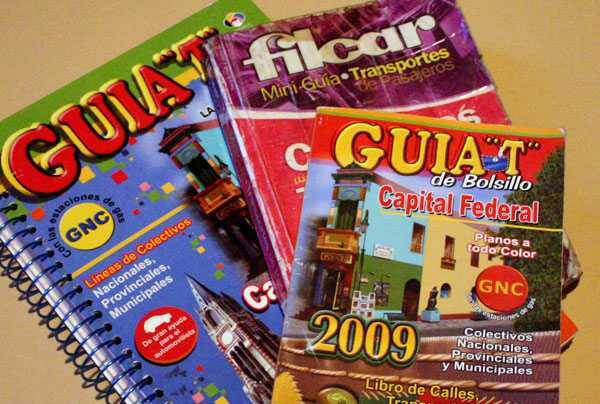
Three guides. Filcar (the easiest to use), and a large and small Guia “T” – The large one details routes outside the city limits.

Learning to take the bus in Buenos Aires will save you a lot of money and is an essential part of a long stay. It is also bewildering to the novice.

One reason for this is the fact that buses here are a system of collective, independent lines (hence they are called colectivos), and while there is no unified system, some things are standard and there are several published guides that can help you make sense of the city in a whole new way.
The more common guide is the Guia “T”. Don’t laugh at my quotation marks. They are a part of the title, and no, I don’t know what the “T” stands for. It is so commonly used that your friends will tell you that their house is in 3-c-4 of the guia. This is the guia they mean.

The one I have found more useful despite its sideways orientation of north is the Filcar Guide.

Each guide contains 3 sections. The first is the map of the city with its corresponding pages and a list of the streets and which addresses fall on which sections of the map.

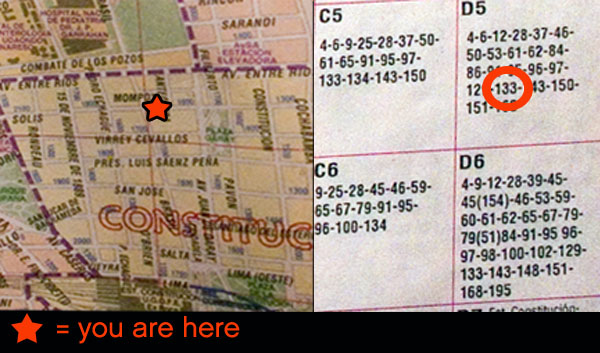
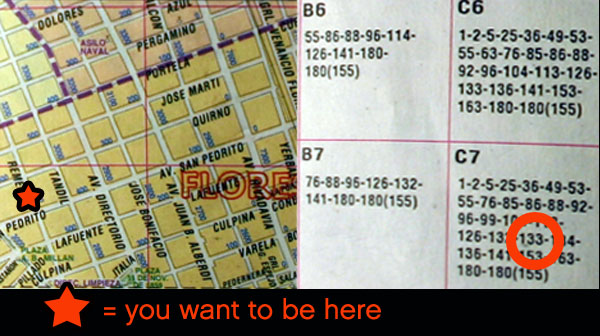
The second part is the map itself, spread over 34 and 29 pages respectively with the facing page detailing which buses pass through the corresponding square on the map.

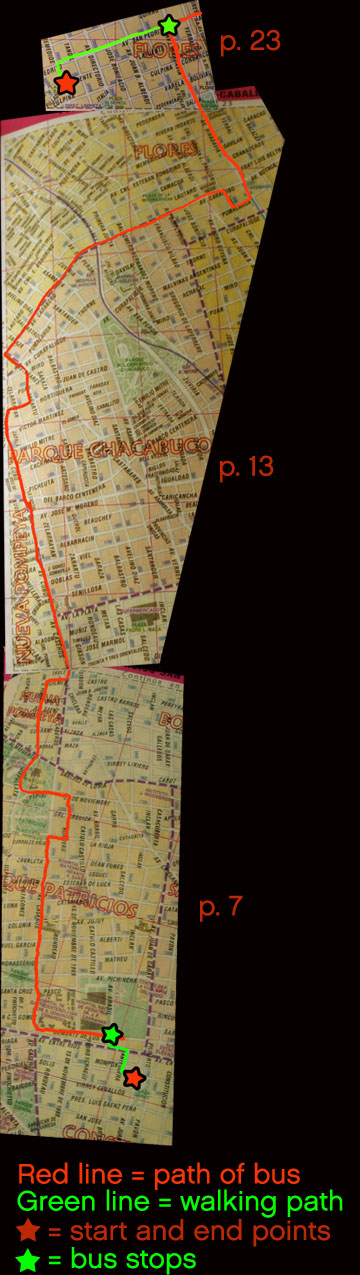
Fig 1. From page 7 of the Filcar guide. City map on the left and corresponding squares that detail the buses that pass through the area on the right.

Fig 2. From page 23 of the Filcar guide. City map on the left and corresponding squares that detail the buses that pass through the area on the right.

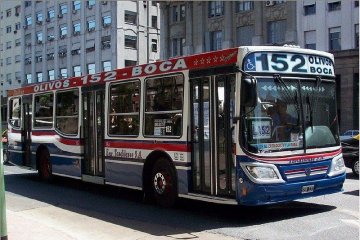
The final section is the listing of the bus routes, which streets they follow, and in the case of the Guia “T” a picture of the bus you can expect, and in the case of Filcar (and the reason I love it so) the street addresses the bus passes en route (which makes it much easier to figure out where to catch and get off the bus).

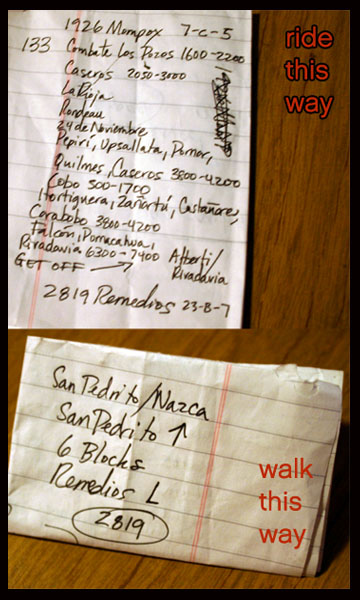
Fig. 3 The author’s paranoid technique that enables her
never to be seen looking at a map or guia.

The route from the 1900 block of Mompox to
the 2800 block of Remedios. Start at the bottom.

As of this publishing date, the most a bus trip will cost you inside Capital Federal is $1.25. You must use change (monedas) on most bus lines and it is in high demand and short supply. Hoard your change as if it were porn in the 1980s and lie to store clerks about having it as if they were your mom.

The length of your trip will define your fare. Very short trips are 1.10 (uno diez) while most trips are 1.20 (uno veinte) and long trips are 1.25 (uno veinte cinco). If you’re shy and don’t want to speak too much, just say 1.25. If you say 1.10, the driver will ask you where you’re going and if you’re bashful you could end up tongue tied and unable to answer. 1.25 never elicits a question.

For this tutorial, I’m taking you from the afflicted sounding Calle Mompox to its cure, Calle Remedios.

The first thing you must do is to locate the address where you are and the address where you’re going in your guide.

Then look in the squares that correspond and see if there are any buses that go through both points. If not, seek in the surrounding squares. (Figs. 1 and 2)

For this trip I’ve chosen Colectivo (bus) 133.

I’m paranoid and neurotic about being seen as a tourist. When going into parts unknown I will often write the bus route on a small piece of paper. (Fig. 3) Instead of dragging my guia out in front of everyone, I refer surreptitiously to my paper to reassure myself that the bus is going where I expect it to and that I know when to get off. I follow the addresses and street names through the windows of the bus. I also detail walking routes that take me to my intended destination.

Once you’ve got your route planned, you can go find your bus stop. You must find a stop with the corresponding number listed on a sign.* Make sure you’re headed in the right direction. Many streets are one way and the bus follows differing return routes accordingly, but in the case that it’s a two way street, check if the addresses are going up or down on your side of the street.

If there are multiple routes of the same number check the sign in the front window of the bus to be sure you have the right one. If you don’t know, ask the driver if the bus passes the intersection where you plan to get off. If you’ve followed my paranoid example, you should nervously be clutching a sweaty piece of paper you can refer to while asking.

Keep your eyes peeled for the bus. When you see it, raise your hand to let the driver know you want to get on. Get a seat if you can. If you’re female, you’ll get priority in many situations. Give up your seat for old people and pregnant women. Hang on for dear life if you’re standing. Drivers brake abruptly.

Web Help: If you prefer a computer screen to the written page, you can find bus routes on the site www.xcolectivo.com.ar, and you can use www.comoviajo.com to help you plan your routes. But if you’re out and about and don’t have a computer handy, nothing beats a guia. Just duck into a cafe and order a cup of coffee and get planning.

Extra Tip: A friend of mine puts a post-it note inside her guia on which she reproduces the colectivos in the squares surrounding her home. This way, she can move the post-it to the page of where she is or where she wants to go to more easily plan her route. She can also quickly refer to it while doing things around the city and see if there’s a sign for a bus that gets her home in the vicinity.

*If you walk the route and don’t see a sign, ask anyone working at a convenience store (kiosco), a cop, or a guy running a diario (newspaper stand) — or ask people standing and waiting for no apparent reason where there is no sign if they are waiting for the bus you want. Usually stops are marked, but sometimes they aren’t and you can walk for blocks only to maddeningly see the driver then stop at blocks you ignorantly walked past.

Community Connection

Matador’s also got bussers covered in NYC and London.

How do you take the bus in your city?


    Share

About the Author

Matador ID: K_Crimini

Kate Sedgwick edits Matador Nights from Buenos Aires where she teaches English, learns Spanish and thoroughly enjoys herself. Her art and writing have appeared in print and on-line publications and her novel in progress will be received with prurient glee by critics of American culture if it ever gets into their grubby little hands. (Author photo by Sebastian Santana).

More By This Author

20 Comments... join the discussion!

  • patricia replied on November 5, 2009

    I`m from Buenos Aires, and altough I have travelled many places, this is my home and Palermo area is where my heart beats. I’ll be happy to help any traveller to get around the city…As from your tutorial it seams crazzy or close to imposible moving around the city by bus…which might be true in a sense…but also this city is beautiful for the arquetecture, cafes, and people. So…don’t hesitate to walk, whenever feel tired stop in a cafe, talk to people…most of them will be very helpfull even if they don’t speak english.
    Un cariño desde Buenos Aires!!!

    (Report comment)

    ↵ Reply
  • Tom Gates replied on November 5, 2009

    I will employ this in two months. Thank you! I can still picture you walking around with all of those crazy books in your bag.

    (Report comment)

    ↵ Reply
  • Jackie replied on November 5, 2009

    Great advice! Check out this site for another good resource (on the bus system and all kinds of things in BA): http://landingpadba.com/colectivos-part-1/

    (Report comment)

    ↵ Reply
  • Candice replied on November 5, 2009

    Oh my god. This is one comically confusing bus system. “Hoard your change as if it were porn in the 1980s and lie to store clerks about having it as if they were your mom.” –> Love that

    (Report comment)

    ↵ Reply
  • Carlo Alcos replied on November 5, 2009

    Love this Kate…I think more because you seem a bit vulnerable! “If you’ve followed my paranoid example, you should nervously be clutching a sweaty piece of paper you can refer to while asking.”

    A side not usually seen ;)

    I really like the idea of the grids and knowing which buses pass through them. Very, very useful article.

    (Report comment)

    ↵ Reply
  • Hal Amen replied on November 6, 2009

    Great job, Kate. And the best part is, with so many buses to choose from, you almost never have to transfer–one route gets the job done. It’s a sweet system.

    (Report comment)

    ↵ Reply
  • Kate replied on November 6, 2009

    Hey! Thanks, guys. And Hal, that’s right if you’re lucky. Sometimes you have to think about how much your time is worth v. how hard it is to get monedas.

    There are some routes a visitor or ex-pat will never figure out that involve taking an express bus 20 miles in the wrong direction to get there faster by taking a train or something.

    When I go to my volunteer job, I save an hour by taking a bus to a subway to another bus, and run out of change FAST. It’s complicated but the best public transportation I’ve come across.

    (Report comment)

    ↵ Reply
  • lu replied on November 7, 2009

    T is because transporte ( bus)

    (Report comment)

    ↵ Reply
  • Frank replied on November 15, 2009

    One word of advice, be careful purchasing these – especialy in newstands. Occasionally they will try to sell you a copy with missing pages. I was told each Guia “T” (not sure about the other guide) are supposed to be wrapped in plastic. So in otherwords, if it´s not wrapped, be careful or at least check to see if it was all the pages.

    (Report comment)

    ↵ Reply
    • Kate replied to Frank on November 15, 2009

      I think that’s insane. Did this happen to you? It sounds like more, “Oooohhhhh – South American Scary for American. Everyone out to rip me off. Better never leave the house!” stuff to me, Frank. The Guias do not come in plastic. I know hundreds of people here and many foreigners and have never heard of such a thing happening.

      (Report comment)

      ↵ Reply
      • Frank replied to Kate on November 15, 2009

        Thanks Kate, for the “Oooohhhhh – South American Scary for American. Everyone out to rip me off. Better never leave the house!” I live in Santiago (Chile) and I lived previously in Mexico. And what makes you think I am American? Are you going to “ohhhh Argentina scary for the rich Chilean, everyone out to rip me off, better not leave my hotel?” So in other words, that’s not the sort of comment that should be thrown out at me.
        And yes, they do come in plastic . At least the second copy I bought did. Also, a local told me that things occurring like this were pretty common and to careful buying books and magazines without the plastic wrapping.
        I bet counterfeit bills, and non-corrupt police are insane and non-existant in BsAs too aren´t they?

        (Report comment)

        ↵ Reply
        • Kate replied to Frank on November 16, 2009

          Yes, well, sorry about that, Frank, but your English seems flawless from here which would actually probably be more likely to make you an Englishman. That and your name led me to believe that you were not South American, but that being said, you’d have a very hard time finding a guide wrapped in plastic.

          The only ones that ever seem to come that way are the large spiral bound comprehensive guides that show routes outside the city – and not too many people buy them in comparison to the pocket guides.

          I will however stand by my assertion that it’s very unlikely that you’ll buy a guia with pages missing. After all, what possible motivation would there be? Unlike the false money (which I have yet to experience) – no one has anything to gain by ripping out guia pages. Also, almost all the diarios keep their guias inside and show them for your perusal upon request instead of leaving them out for miscreants to rip to shreds.

          (Report comment)

          ↵ Reply
  • Frank replied on November 16, 2009

    As to why someone would want to rip out pages is beyond me too. This copy didn´t come with pages ripped out, they were simply missing as if the publishing house as failed to include all the pages. It was clearly a manufacturers defect and knowing the demand for such products, a newstand might be still willing to sell them. Also the guias at the two newstands I went to were just sitting out in front of the newstand – who knows, maybe I just picked the wrong 9 de Julio newstand and got lucky. And I´m not necessarly saying the sales person even knew even though she gave me an odd look when I asked her if it was the most current verstion of the guide – although she was probably just thinking what a dumb question since it says right on the cover. But whatever, my local porteño buddies told me about the “risk” (okay i was meerely a couple bucks) of buying those guias and other published products from news stands if they are not wrapped in plastic.
    As for the counterfiting money, I experienced it the second trip I made to Ar.
    and haha, I´m not and Englishman either….

    (Report comment)

    ↵ Reply
  • Katie Oakes replied on November 18, 2009

    aaarrgghhhh! i’m definitely going to get lost! i’m heading to buenos aires in a few months, and this article will be printed off and stuck inside an indiscrete notebook, so as not to look too touristy! I fear my very confused expression may give the game away though! Thank you for sharing this!
    Katie

    (Report comment)

    ↵ Reply
  • Jill replied on November 18, 2009

    Gracias, pero no. I’ll take the subte!!! Lol.

    (Report comment)

    ↵ Reply
  • Ignacio replied on November 19, 2009

    Hi Kate, Its called Guia “T” for GUIATE (guide yourself)… is not for Guia Transporte as it was mentioned.

    (Report comment)

    ↵ Reply
  • carol replied on November 25, 2009

    Can you advise where on Rivadavia we would catch bus 45 or 37 to Jorge Newbery airport? We leave tomorrow morning early, Nov.26.

    Thanks

    (Report comment)

    ↵ Reply
  • ezequiel replied on December 10, 2009

    Hi, i’m from Argentina, currently living in Caseros, and i traveled a lot around BA, and i see that your guides are really complete,and about the issue with counterfeit money, the bills more likely to be fake are anything above $2 (dos pesos) , if u want to make sure if a bill is real or not, hold it up to a light source, like the sun or a bright lamp, and on one of the sides of the bill, on the left of the procer (the historical figure on the bill) you should see a translucent image of the same guy, and if you have one of those little lanters with the purple light, you should see some neon “hairs” on the bill itself, if see this things, it’s most probably legit, so, good luck with that =) (sorry if my english is a little rusty, i mostly use it in online games this days )

    (Report comment)

    ↵ Reply
  • Juan replied on January 29, 2010

    An advice from a local…..visit http://www.comoviajo.com…outstanding page.

    (Report comment)

    ↵ Reply
  • Allison replied on June 17, 2010

    Great bus advice article. It took me almost a year to master the guia T and now I am pro at it. Once you realize how to use it, it becomes your ultimate Buenos Aires best friend.

    (Report comment)

    ↵ Reply

Leave a Comment

Get Matador in your inbox and around the web.

Sign up for our FREE weekly newsletter.


View full list of RSS feeds

Jump To Category:


Explore the Community


Popular Stories on Matador

Experience the Art of Improv Travel

Travel is more about how you do it, not where you go. F... 

5 Intense Wilderness Rescue Stories

Flooded caves, helicopter crashes, and armed rebels cou... 

Essential Packing List For Artists

Through art, one can learn about a culture's history an... 

Natural Remedies From Around the World

Try these natural homemade remedies from around the glo... 

Urban Homesteading: Turn Your City Home Into Country Living

Who says you can't have a farm in the backyard of your ... 

24 Hours at Burning Man

A day in the life of a burner.... 

Call for Submissions: Tales From The Frontier of Expat Life

I'm looking for stories about expats exploring the comp... 

How To Travel The World For Free (Seriously)

World travel can be much cheaper and far less stressful... 

Friday Fun: The One Hit Wonder Down Under

The snow’s long gone in the northern hemisphere, but ... 

On Being an Athlete: Why Do We Believe We Can't Do It?

Thoughts on the process of going from "normal human" to... 


Focus


Editor Blogs