Photo above: sebastian ceriani, Feature photo: Army.mil
Central Laos does not get many travelers, and the tourism office in the provincial capital of Tha Khaek has done a good job of designing treks that alleviate poverty in isolated villages without disrupting local culture.
Travelers get a chance to experience a beautiful part of rural Laos where the locals take pride in hosting foreign guests – a happy balance that does not always exist in more heavily touristed regions of Southeast Asia.
Basics
The 2-day trek costs about $65 per person for a group of at least 3 people — more for couples or single travelers. This is a fair price, and much of the money goes to local villagers who guide groups through the mountains and cook delicious meals.
Travelers start out in Tha Khaek, a medium-sized town on the Mekong River that’s about halfway between Vientiane and Pakse.
There’s a wonderful guesthouse in Tha Khaek called The Travel Lodge that has a range of inexpensive rooms, a good restaurant, and friendly, competent staff. If you’re on your own, this is also a good place to meet other travelers who can join you on the trek.
Destinations
Phu Hin Bun NPA
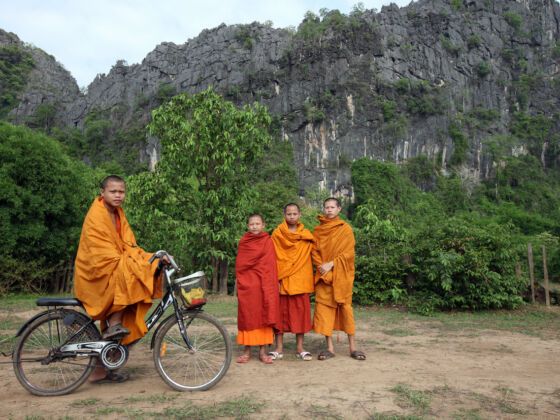
The trek explores the Phu Hin Bun National Protected Area, an isolated region of jagged peaks and clear, turquoise streams that looks like a classical Chinese landscape painting. The sheer mountainsides are refuges for several species of endangered primates, and tigers stalk the deepest parts of the jungle.
The villagers who live in the Phu Hin Bun NPA are largely self-sufficient, growing rice, fruit and vegetables, and raising water buffalo, pigs, chickens, and cows. While many treks in Laos visit ethnic minorities, the villagers here are mostly lowland Lao.
Eat, Walk, Swim
I LOVED the food on this trek. Fresh catfish grilled with garlic over a campfire on the banks of a stream was served alongside sticky rice, mountain vegetables, eggplant, and traditional pastes of herbs and chili.
For dinner we ate water buffalo laap, a Lao dish of minced meat with herbs and spices. Vegetarian options were limited but available.
The walks through the forest were broken up by frequent stops at spectacular swimming holes, including a sacred wellspring of turquoise water called Khoun Kong Leng.
Other highlights included a cave that links two valleys by cutting straight through a mountain, and an old temple where the prayer bell was made from the shell of a 500-pound bomb. This bombshell was a poignant reminder of the massive U.S. bombing campaign of rural Laos — a war that the White House kept secret from both Congress and the American people.
Cultural Respect
Visiting this part of Central Laos is a privilege, and travelers should take care to respect Lao customs. Understand that Lao people are extremely non-confrontational and place a premium on smooth social interactions.
Be gentle, kind, patient, and appreciative. Showing any sign of frustration or anger is extremely rude in Laos, so if you don’t like something it’s better just to smile and, if you must, gently inquire about alternatives. The head guide will speak reasonable English, but speak slowly and try to learn some Lao words. Everyone will be thrilled to hear you make the effort.
Photo: Mat Honan
Community Connection:
Other Matador articles on Laos include travel guides to Champasak and Muang Ngoi Neua, and an excellent article that gives the low-down on a unique two-week itinerary in Northern Laos.
You can also read the uncensored version of my San Francisco Chronicle feature on Luang Prabang, the ancient royal capital of Laos. The Matador version is called “Lusty Luang Prabang.”
One final resource is the excellent website Ecotourism Laos.
If you have other helpful links, questions, or advice for travelers, please leave a comment below. For those without a Matador profile, please take a moment to join the community. You won’t regret it!
About the Author
Related Posts
3 Comments... join the discussion!
-
-
Thanks Charlane and Carlo! There’s a lot to explore in Laos.
↵


