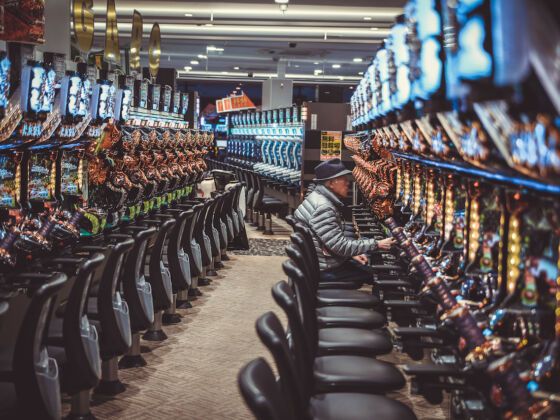
Photo above: Tavallai
1. Don’t… play pachinko
Pachinko is one of the few ways to legally gamble in Japan, but don’t be lured into a parlor thinking you’ll see attractions like those of Vegas. The place is beyond loud, and full of cigarette smoke.
The games themselves should be reserved for a 10th circle in Dante’s Inferno. Imagine a pinball machine with a computer screen display; once you pull the lever you have literally no control as to where the ball ends up.
Just like in Vegas, you’ll find burnt-out slot jockeys mechanically inserting yen, winning once every 27 days. Fun fun.
Photo: Steph & Adam
Do… sing karaoke
A karaoke booth with an all-you-can-drink special is a much better alternative if you want to be surrounded by video screens and loud noises.
It’s nothing like a country-western karaoke bar in the U.S.
All the booths in Japan are private, so you can only make an ass of yourself in front of close friends.
The Shidax chain is my favorite, but every town should have at least one place to sing.
2. Don’t… climb Mt. Fuji when there’s a line
Fuji is swamped with foreign and Japanese tourists in the official hiking season (peak in August), and completely overwhelmed during the Obon holiday week.
By this, I mean you’ll have to wait in line the entire climb and struggle to crop people out of your photos.
Do… climb in the off-season
Photo: Ryuugakusei
Late September and October would be “safest,” with minimal snow, but if you want the trek to yourself, bring the right gear and see if you can get permission from the 5th station to go in November or December.
Obviously, this can be rather dangerous, and I don’t recommend it to anyone who doesn’t have mountaineering experience. Attempting the ascent early, in May or June, can be just as risky with the rains.
If you’re looking for an alternative path to the summit, check out the Fuji Mountain Race.
3. Don’t… drink at the Lost in Translation bar
The film-famous establishment is located at the top of the Park Hyatt in Shinjuku and should be avoided by all but the most fanatical Johansson/Murray fans.
Unless you enjoy paying 4,000 yen (USD40) for a fruit and cheese platter.
Do… enjoy city views elsewhere
The gallery and coffeeshop atop Roppongi Hills immediately comes to mind.
4. Don’t… pay to dress like a geisha
This is an activity many Kyoto guesthouses and hostels offer for the ladies (maybe the men too?).
Photo: FranUlloa
For about 10,000-30,000 yen (USD100-300), depending on services offered and time allowed, your face will be painted pale white, your hair arranged in traditional geisha style, and your body stuffed and folded into a slim silk kimono.
Why? For photos to send home…the chance to see what geisha experience…sometimes you’re allowed to take a short walk outside in full regalia and watch the reactions of startled Japanese men and tourists thinking “Wow! A real geisha! Get the camera!”
Unfortunately, it’s just not worth it; with foreign noses, eyes, and facial features, we simply look ridiculous.
Do… meet the one foreigner who can pull it off
American-born Sayuki, currently working in the Asakusa district of Tokyo: www.sayuki.net
5. Don’t… travel far and wide for cherry blossoms
Imagine you’ve just flown into Tokyo one Sunday in April; those flowering trees that have inspired thousands of haiku and drunken hanami (viewing parties) are now in full bloom and ripe for the watching.
Photo: ajari
Instantly, you think: “I’ve got to get to the best viewing spots in the country, quickly!” Many travelers do this, following the spread of the sakura (cherry blossoms) from the south of Okinawa in February all the way to Hokkaido in May.
If you ask me, it’s not worth the effort.
Do… check out your local sakura
The very best blossoms might be right where you’re at. Every city, town, and prefecture in Japan has a great place to lay down a blanket, crack open an Asahi, and view the pedals falling as gently as snow.
I won’t deny there are some great trees out there, but don’t feel pressured to rush out of town; cherry blossoms bloom for only one week, and even with reliable sakura forecasts, it’s difficult to schedule a holiday precisely around full bloom.
Instead, take advantage of your present surroundings.
6. Don’t… restrict your WWII studies to hiroshima
Japanese World War II history goes way beyond Hiroshima City’s Peace Museum, A-Bomb Dome, and Paper Crane Memorial. By all means, visit each of those, but once you finish…
Do…
* Take the train over to Nagasaki and tour its Peace Park. Did you know Kokura was the original target on August 9th, but cloud cover caused the pilot to divert to Nagasaki?
* Really go off the beaten path with the Kamizake Museum in Chiran, Kagoshima Prefecture. Hundreds of letters are on display, written by pilots as goodbyes to their families.
* Visit the controversial Yasukuni War Memorial shrine in Tokyo, which honors the spirits of those fallen.
7. Don’t… see Japan through emerald glasses
For most foreigners coming to Kyoto, [the cityscape's distasteful modernity] merely whets their appetite to find the old Japan they know must be there. When they finally get to Honen-In Temple and see a monk raking the gravel under maple trees, they say to themselves, “Yes it does exist. I’ve found it!” And their enthusiasm for Kyoto ever after knows no bounds. The minute they walk out of Honen-In they’re back in the jumbly modern city, but it doesn’t impinge on the retina – they’re still looking at the dream.
Dogs and Demons: The Fall of Modern Japan, Alex Kerr (quoting Mason Florence)
Most Japan newbies are on the hunt for “old Japan”: Zen temples with chanting monks, samurai warriors parading the streets.
But the truth is, even though a few pockets of the country have successfully preserved it, that Japan has been fading from existence since the 1960s.
Photo: Shadowgate
Do… question the value of unchecked modernization
At some level we all appreciate the fancy robots and electronics in Akihabara, the high-speed trains, the capsule hotels.
I’m not saying you shouldn’t enjoy your Japanese holiday by reaping all the benefits of modernization. Just be aware of some of the things the country has given up to get to this point.
Community Connection
More from Matador’s destination expert on Japan:
Shima to Shima: Southern Islands of Japan
About the Author
Related Posts
21 Comments... join the discussion!
-
-
Good points. Having lived over a year in Japan I agree with most dos and don’ts here (although I’d skip Mount Fuji alltogether – climbing a cone of gravel has very little interest – and enjoy some of the less famous but more interesting mountain climbing).
↵ -
Hemanth, Japan is a first world country, so compare the expenses with travelling in Europe or North America, not South East Asia… Transportation and accomodation can be expensive,especially if you don’t speak the language and can’t find the cost saving solutions. But food is a lot cheaper than in Europe, and many of the points of interests are free (of course this depends on what you came to see).
↵ -
Interesting….I had no idea there was an actual line to climb up Fuji. Crazy.
↵ -
Love the format of the article, I want to see more like this!
Great work Turner! My roommate just got back from a visit to Japan and warned me about pachinko! yuk!↵ -
Nice article! Super informative. I’ll be bookmarking this for the future.
↵ -
These are great; I’m always fascinated by cultural do’s and don’ts around the world. It’s like a quick immersion into another place. So cool. And I love the “don’t play dress up” tip, because who wants to look like the clueless tourist? No one.
The NileGuide blog actually just did a similar post! We had our Local Experts around the world give their top few do’s and don’ts for their destinations. Check it out here for some advice outside of Japan.
↵ -
Don’t…visit Japan with zero Japanese words in your repertoire. If you step off the plane at Narita Airport only knowing “konichiwa” and “sayanora” then prepare for a lot of short, polite, semi-awkward conversations during your stay.
In my experience, the Japanese know very little English and have difficulty pronouncing it correctly.
My longest conversation with a local was actually in Spanish with a Japanese student who was majoring in that language. All my English conversations consisted of quick small talk.
Do…learn these 16 words/phrases to start…
excuse me = sumimasen
can i please have? = kudasai
yes = hai
please = one gai she masu
do you have? = ari masca
i don’t have = ari masen
i have = ari mas
where = doko
water = mizu
tea = o’cha
coffee = kohey
this = kore
can i have this? = kore kudasai
thank you very much indeed = domo ari gato gozi mashta
check please = (just cross your two index fingers)
have a nice trip = kiotzketeThis is a good start. If you want to take it further, download “Rapid Japanese: Volume 1 (Earworms Learning)” from iTunes for $10. Listen to it in your iPod when you’re laying down to go to sleep at night.
Japanese is a lot easier for English speakers to learn, than vice-versa.
Kiotzkete!
↵ -
I may still want to do it, but Fuji’s lines are a little off putting. If I wanted lines like that I could stay home.
The views are magnificent I’m sure, which may make it all the worthwhile tho…
↵ -
Good analogy, Carlos. Once I read up on Milford I knew I wanted to head down there, but the crowds… well, like Fuji, just ruin it for me. When I’m doing a hike like either of those, though it may impossible, I want to be alone.
↵ -
Might have to grab my camera and shoot some pachinko scenes and do an insiders Tips Article someday. I don’ gamble anymore, but there was a time…
Cool post and it is a novel format; be great to see more like this.
↵ -
Nice one Fresh Airfare on giving those quick words & phrases to start with when travelling to Japan. My Japanese at school only left me with the phrase of ‘My I have your phone number?’ something us kids loved to toy the girls in class with.
40USD for a cheese platter = you’ve got to be kidding me!
Kanpai!
↵ -
To be fair, the strawberries were divine…
↵ -
I’ve lived in Japan for over a year now, and it’s funny that I’ve done almost all those things mentioned by the author NOT to do… including the expensive cheese platter (which I would not order again, but another thing on the menu at that bar (duck fat fries)? Absolutely worth the price!)
I’m all for doing things off the beaten track, but in my experience, I actually have to disagree that somehow those experiences are less than interesting or insightful or fulfilling in some way… in fact, I’d say that it’s limiting to go into a country as a traveler and go by someone else’s list…
sure, you may not want to have to deal with masses inside smoky pachinko parlors or on Mt Fuji, but the crowds, the expense, the drunken cherry blossom viewing are all aspects that make this place wacky and distinct, and I want to experience that in addition to hidden treasures that I stumble on.
When we’re on a budget and limited time, it’s nice to know what other people recommend, but like blockbuster movies and restaurants, you have to take someone else’s word as a grain of salt. We all travel with different goals and motivations inside… we can’t expect a place to entertain us; it’s up to us to appreciate the destination for what it is- crowds and smoke and cheesiness and all.
↵ -
Telling people to climb Mt. Fuji off-season is quite irresponsible. Fujiyoshida City’s official site equates winter conditions to an “8000m Himalayan peak … dangerous for even the most professional alpinists”, and the mountain can and regularly does kill people who do not believe this.
http://www.city.fujiyoshida.yamanashi.jp/div/english/html/winter_climbing.html
↵ -
To be fair, Turner addressed all this, stated when the “safest” is for off-season, and even said he doesn’t recommend it unless you have mountaineering experience and also to get permission. He even mentioned that pre-peak season can be dangerous as well because of the rains. I believe he covered his bases there.
↵ -
I’m well aware of that, Jani. I believe I told others of the dangers as well. The issue is having the best experience on Fuji, and I personally believe you can’t really do that walking in a line 90% of the way.
↵ -
I think you can find more information at gojapan.about.com/od/attractions/u/whattodoinjapan.htm ortripadvisor.com/Attractions-g294232-Activities-Japan.html .
Thanks
↵


